“Every throw is always the first throw”
The Narrow Road to the Deep North“Every throw is always the first throw” is Darky Gardiner’s image of chance as a series of beginnings, untouched by what has come before. The saying offers a way to imagine uncertainty without accumulated odds or guarantees; the war that interrupts its telling gives that idea a darker force, while Dorrigo Evans’s later recollection makes it a fragile comfort against memory and loss.
The coin-toss maxim
Darky introduces the thought while producing a bottle of cognac, topping up the men’s coffee, and describing a wager on two coins. Even after two heads have appeared three times in a row, he explains, the next throw is statistically just as likely to produce two heads again. The past does not make the next result safer or more predictable. His conclusion, “Every throw is always the first throw,” compresses that reasoning into a portable rule for living with uncertainty. He calls the idea lovely, presenting the reset not as a calculation alone but as something that might console.
Chance made immediate
The conversation takes place among Dorrigo, Darky, Jimmy Bigelow, and Yabby Burrows shortly before a shell strikes. Darky has just been called a survivor, and Dorrigo has wagered ten shillings that he will make it through the war. When the shell arrives, Darky pulls Dorrigo down by the arm; the blast destroys the blue armchair beside them. After the men call to an Arab boy to get down, Yabby runs toward him. A second shell hits, and shrapnel kills the boy before anyone can reach him. The scene gives Darky’s abstraction an immediate, brutal counterweight: each moment may begin anew, but a fresh chance is no promise of survival. The ten-shilling wager remains unpaid.
Dorrigo’s later recollection
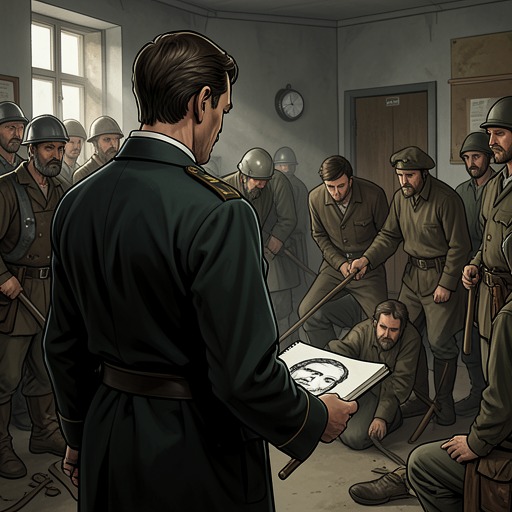
Years later, while trying to write an account of Darky’s beating, Dorrigo finds that he has not thought of him for years. He is also preparing a foreword to a book of sketches and illustrations by Guy Hendricks, a prisoner of war who died on The Line; Dorrigo had carried and hidden Hendricks’s sketchbook for the rest of the war. As he speaks with Lynette Maison, the dirty, moving sky of the Speedo returns to his thoughts. He remembers Darky’s maxim and recognizes its connection to the wager-like contingency of the war, but cannot summon Darky’s face, singing, or sly split smile. What comes back instead is the sky receding from the horror. The expression thus changes from a spoken wager on possibility into a measure of what Dorrigo cannot recover: the man who offered it remains obscured by the landscape of violence in his memory.